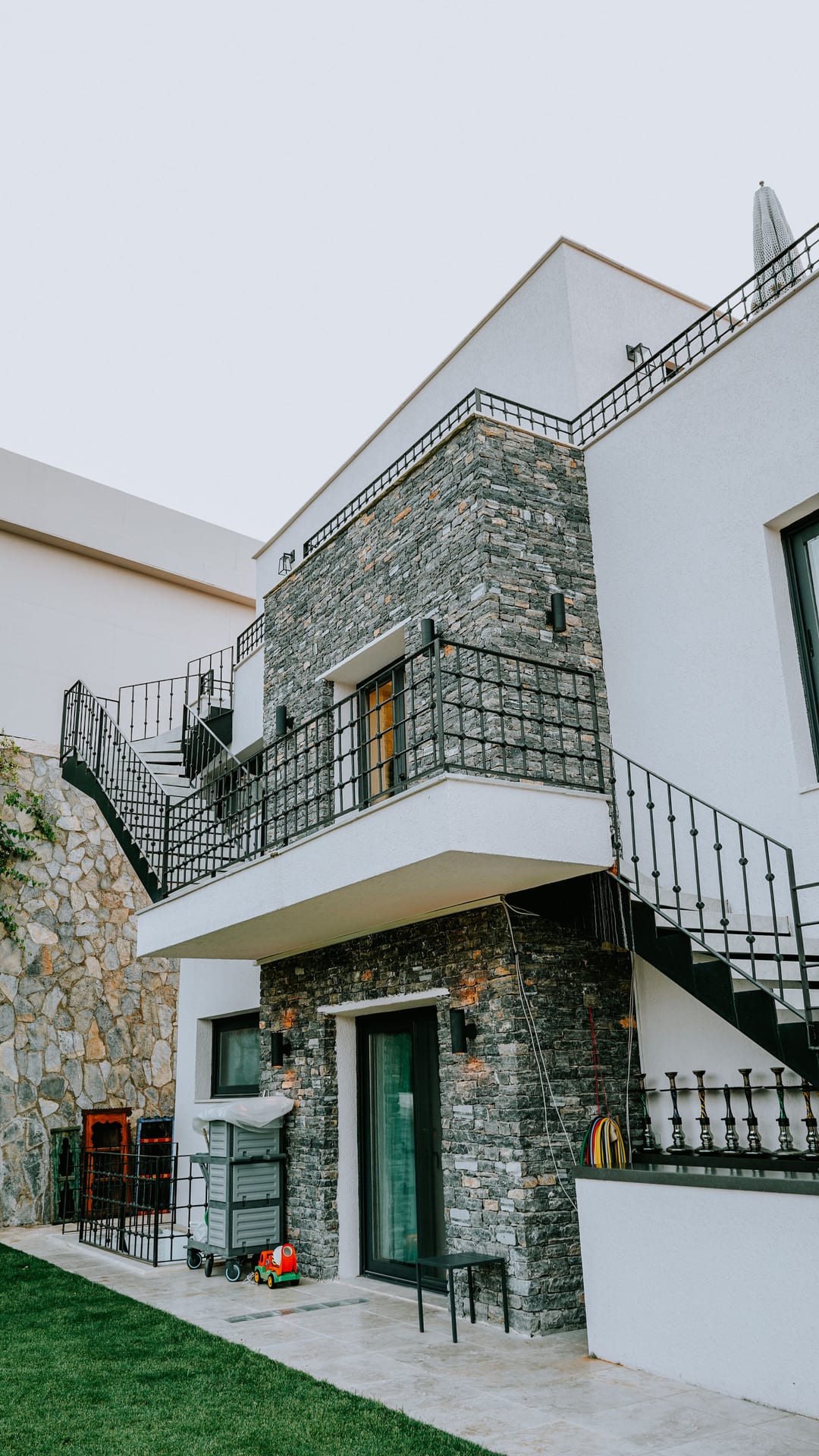
A significant part of the building stock in Alanya and its surroundings on the Mediterranean coast consists of buildings constructed to older earthquake regulations and exposed for years to high humidity and the salty coastal climate. Demolishing buildings and rebuilding them through urban transformation is both costly and requires a long evacuation period. Column strengthening in Alanya makes buildings whose load-bearing system is damaged, corroded or inadequate in earthquake performance safe quickly and economically, without evacuating them.
Main Causes of Column Damage in Alanya’s Buildings
Buildings on the coast are exposed to far more aggressive environmental effects than structures in a continental climate:
- Reinforcement Corrosion (Rusting of the Steel): High humidity and sea salt seep into the concrete, causing the load-bearing bars to rust and thin, and the expansion in volume bursts the outer concrete.
- Use of Sea Sand: In buildings from before 2000, the use of unwashed sea sand significantly reduced the strength of the concrete.
- Insufficient Stirrup Spacing: Stirrup spacing at column-beam joints that does not meet the standards needed to withstand seismic shaking.
- Alterations to Ground-Floor Shops: Uncontrolled alterations made across Alanya, in buildings with shops on the ground floor, to open up a shop window or gain space.
- Low Concrete Class: Old concrete classes such as C14 and C16 that lose their load-bearing capacity over time.
What Are the Column Strengthening Methods?
Depending on the degree of damage to the existing building, its structural requirements and its intended use, 3 main methods are applied:
1. Column Strengthening with Carbon Fibre (CFRP)
Carbon fibre reinforced polymer (CFRP) fabrics are applied by wrapping them around the column with high-strength epoxy resins.
- Advantage: It does not enlarge the column section, causes no loss of space, is extremely light and is completed within 1-2 days.
- Where It Is Used: Columns whose concrete quality is above a certain threshold and whose compressive and confinement strength needs to be increased.
2. Steel Jacketing
L-profiles (angle sections) are placed at the four corners of the existing reinforced concrete column and welded to one another with steel straps.
- Advantage: It immediately increases the column’s ductility (energy absorption capacity), and installation is quick and effective.
- Where It Is Used: Columns with inadequate shear and axial load capacity.
3. Reinforced Concrete Jacketing
The cover of the old column is broken away, additional ribbed bars are anchored to the existing reinforcement, formwork is fixed around it and high-strength non-shrink concrete is poured.
- Advantage: It is the traditional method that increases load-bearing capacity the most.
- Where It Is Used: Ground-floor and basement columns that have suffered serious loss of section and carry heavy loads.
Column Strengthening Methods Comparison Table (2026)
| Strengthening Method | Loss of Space | Installation Time | Added Load / Weight | Strength Gain |
|---|---|---|---|---|
| Carbon Fibre (CFRP) | None (1-2 mm) | Very Fast (1-3 Days) | None | Confinement & Ductility |
| Steel Jacketing | Low (3-5 cm) | Fast (3-5 Days) | Light | Axial & Shear |
| Reinforced Concrete Jacketing | High (10-15 cm) | Medium (7-14 Days) | Heavy | Axial & Bending |
The Stages of Column Strengthening in Alanya
A proper strengthening job must be carried out through engineering steps:
- Building X-ray and Core Testing: The compressive strength of the concrete is measured, and the corrosion state of the reinforcement is scanned with ultrasonic devices.
- Structural Calculation and Design: A 3D simulation of the building is produced and the columns to be strengthened are identified.
- Surface Preparation and Rust Removal: Rusted bars are cleaned by sandblasting and anti-corrosion chemicals are applied.
- Strengthening Installation: Carbon fibre wrapping, steel frame installation or reinforced concrete formwork is carried out.
- Testing and Handover: After application, pull-off tests are carried out to certify the safety of the load-bearing system.
Frequently Asked Questions (FAQ)
Does the building have to be evacuated during column strengthening?
With carbon fibre (CFRP) and steel jacketing, the building does not need to be evacuated completely. Work can be carried out in the relevant individual unit only.
How much does column strengthening increase a building’s earthquake resistance?
A properly designed strengthening scheme brings the structure up to the current Turkish Building Earthquake Code (TBDY) standards and eliminates the risk of collapse.
What determines the cost of column strengthening in Alanya?
It is determined by the number of columns, the chosen method (carbon fibre, steel, reinforced concrete), the degree of damage and the number of floors. The exact cost is worked out after an engineering inspection.
How long does carbon fibre (CFRP) strengthening last?
Carbon fibre polymers that are correctly applied and protected against UV rays keep their strength without corroding for the life of the building.
Is an official permit or licence required before strengthening?
For extensive strengthening that intervenes in the load-bearing system, a structural design must be prepared and a strengthening licence obtained from the relevant municipality.
Expert Engineering Solutions in Alanya: Refix Alanya
Across Alanya (Mahmutlar, Oba, Tosmur, Kestel, Alanya Centre), our professional survey team is with you to increase your building’s earthquake safety and to modernise cracked and corroded columns.